In the Edo period, since 1603, the Tokaido 東海道 and the Nakasendo 中山道 (or Kisokaido 木曾街道) are the most important roads from Kyoto to Edo (Tokyo), with a post station every few kilometers for resting, eating, sleeping. Used for trade, travel, religious and daimyo (feudal lords) processions, these roads were described early in small illustrated guidebooks. The rest stations along the road became a favorite theme for woodblock artists in the 19th century. One would design a different print for each station, up to 55 for the Tokaido and 71 for the Nakasendo! Publishers welcomed those big series of prints because they had a large urban public. Many series were produced. But to achieve some success, a new one had to represent the stations in an original, surprising fashion.
To explore this diversity of woodblock print Tokaido series, we have chosen to focus on a single station, KUSATSU, and to review its representation across series and artists. Surprising!


We hope these few slides around Kusatsu have shown how the Tokaido was fully exploited by Hiroshige, inspired by Hokusai and helped sometimes by a few other artists like Toyokuni. Hiroshige contributed also to the fame of the Kisokaido Road, but to a much lesser extent and with only one series.
The contribution of Hiroshige on landscape art was essential (and would be copied later in many instances). His prints were documentary, in the sense that they always brought reliable information on the landscape around the post station. They were also very artistic and creative, although quality of the series could be variable, some of them being done essentially for a commercial or a social reason. But his most important series brought a real revolution in Ukiyo-e!
The idea of using the long sequence of post stations to produce series of woodblocks where a single theme and the sequence of stations were associated was brilliant, for the artist, for its publisher, and for the public eager to learn about their country while following a guiding thread.
Consequently, beyond the promenade in Japan through the post stations, this serial Tokaido approach excited the imagination of Hiroshige’s contemporaries, as the next following slides will hopefully show you…
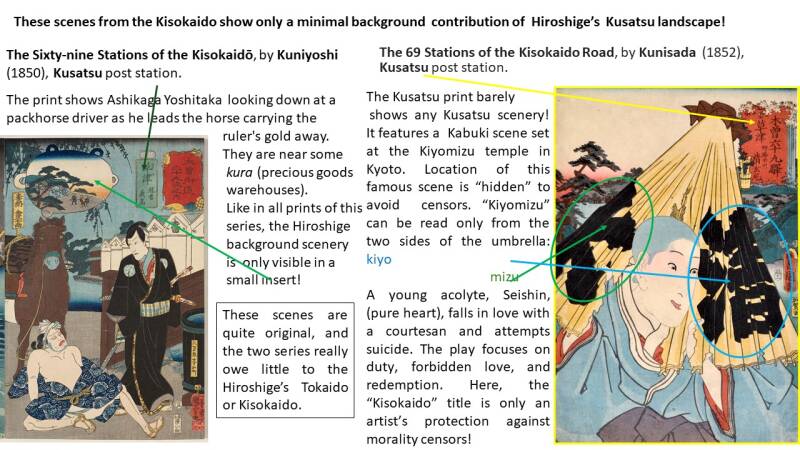
The Tokaido and the Kisokaido stations were even used as a background decoy to propose foreground scenes forbidden (like Kabuki actors) after the « moral » reform imposed by the feudal Shogunate in the 1840’s.






To summarize the whole story, thirty different Kusatsu station prints from the Tokaido (27) and Kisokaido (3) series were found.
Six woodblocks were from Hokusai with scenes of the ferry crossing and of local food or medecine specialties. Nearly half the prints were by Hiroshige Ando, all showing scenes clearly associated to Kusatsu, like the post station, the ferry crossing, the crossroads and people nearby. His work inspired directly Hiroshige 2 and a few other artists who borrowed extensively from his scenes for their own Kusatsu prints.
In the few prints with a controversial content, like a kabuki actor or a prostitute, the Kusatsu background was barely visible! For those prints, titles with « Tokaido » or « Kisokaido » were just a front to soften censors…But they were also really original and beautiful, and it may have helped!
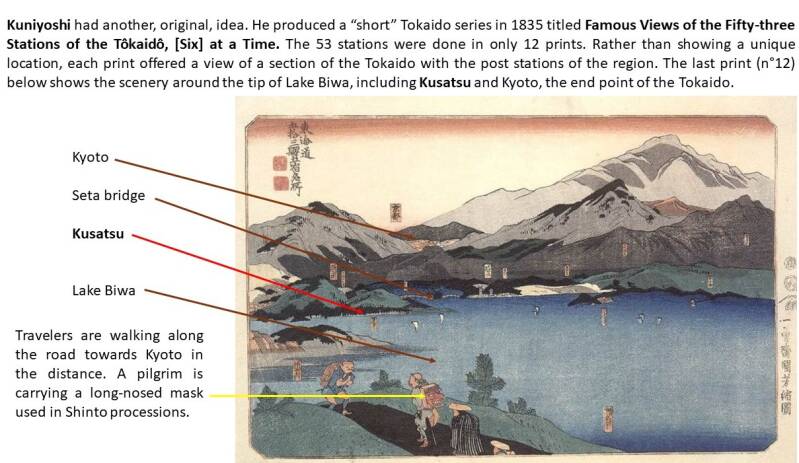
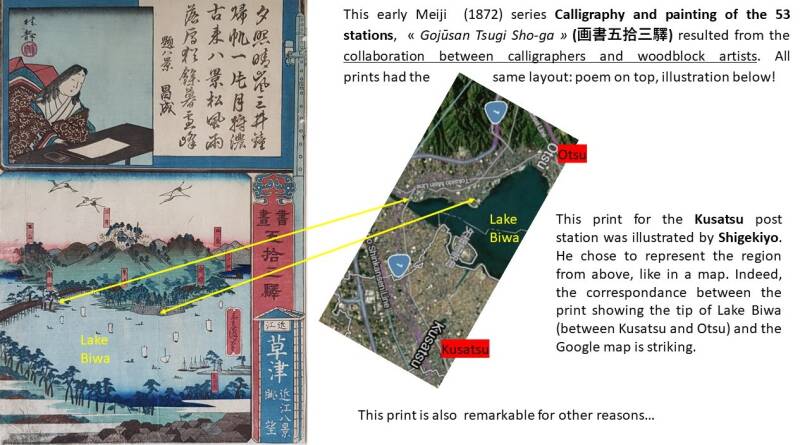
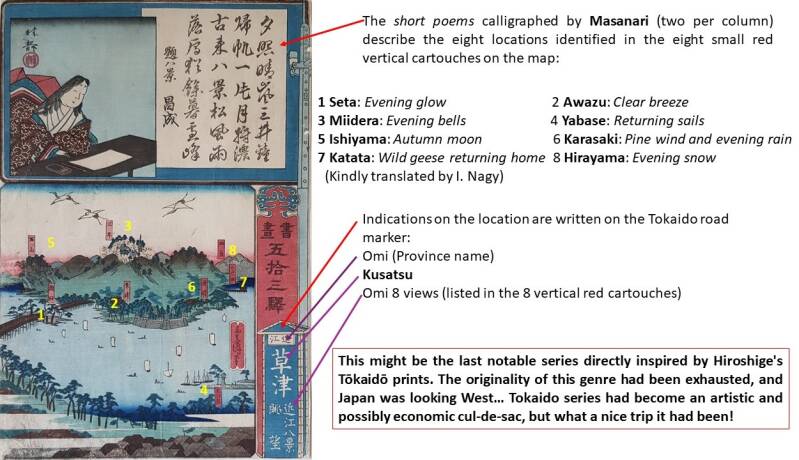
Finally, few atypical prints were produced, with added calligraphy or bonsai scenery, and even with cats only!
It was a pleasure for us to appreciate the diversity of artists’views on the Kusatsu rest station. For you too, we hope…
Research and writing: Francis Minvielle
Support and preparation of the French version: Franck Girard
Thanks to:
Nagy for many translations
Matteo Vassout for kindly correcting historical and other factual errors
Francine Minvielle for reading early versions and photo credits
Wikimedia
Keio University
Hiroshige.org.uk
MFABoston
Artelino
Emilie for Kusatsu photo credits
Asian Arts Forum
Add comment
Comments